Rome feels three-dimensional on this walk. You get 3D augmented reality layered onto the big landmarks, plus the steady, human explanations from archaeologist Anastasia as you weave through lesser-seen corners of the center. I also like how the route is built for stories, not just photos—so your phone becomes a tool for understanding, not a distraction.
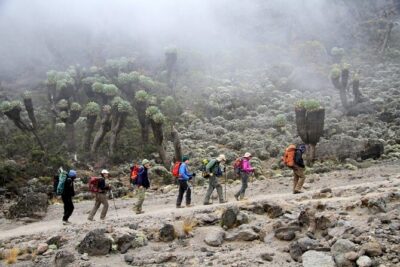
One thing to plan for: it’s still a walking trek with uphill and downhill sections, so you’ll want solid shoes and moderate stamina. On a hot day, bring sun protection and water, and if weather turns ugly, the guide can adjust or cancel to keep it comfortable.
In This Review
- Key highlights at a glance
- Why This Archaeologist-Led Trek Beats the Usual Rome Loop
- Your Phone as a Time Machine: 3D AR on the Move
- Teatro di Marcello: The Theater That Looks Like a Castle
- Ghetto Ebraico di Roma and Tiber Island: Neighborhood History on Foot
- Bocca della Verità and Santa Maria in Cosmedin: Testing a Legend
- Foro Boario and the First Marble Temple: Seeing Early Rome’s Power
- Giardino degli Aranci (Aventine Hill): Views Plus a Great Optical Trick
- Buco della Serratura and the Knights of Malta: A State Within a State
- Testaccio Market and Street Life: Where Rome Feels Local
- Piramide Cestia: Egyptian-Style Rome and a Wealthy Magistrate’s Taste
- Timing, Meeting Point, and What to Expect From the Walk
- Value Check: Why $3.61 Can Make Sense Here
- Should You Book This Urban Trekking With an Archaeologist?
- FAQ
- How long is the Rome urban trekking experience?
- What group size should I expect?
- Is it offered in English?
- Where does the tour start and when?
- What should I bring for the walk?
- What if the weather is bad?
Key highlights at a glance
- Archaeologist Anastasia leads a max 10-person group, so you can actually ask questions
- Phone-based 3D augmented reality brings ancient Rome to life as you move through the area
- Free admission ticket stops are part of the itinerary, which makes the value feel unusually strong
- Anecdotes you won’t get from a standard script, including fish tax and the recycling of marble
- Real Rome stops like Testaccio, where daily life mixes with ancient remains
- Several “you have to see it” moments, like Bocca della Verità and the Aventine Orange Garden optical illusion
Why This Archaeologist-Led Trek Beats the Usual Rome Loop
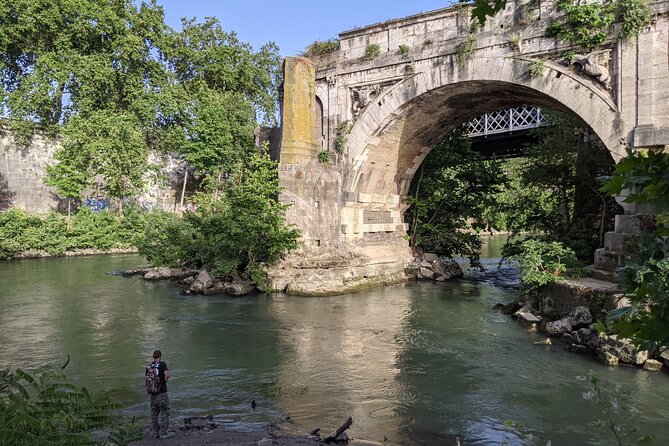
Rome can feel like a list: Colosseum, Forum, maybe a fountain, then back to the hotel. This walk flips that. Instead of rushing through monuments, you connect the dots—how people lived, argued, ate, built, reused, and worshipped.
The big win is the guide. When archaeologist Anastasia is talking, it’s not just dates on autopilot. The pace is conversational, and the group stays small (up to 10). That matters in Rome because you can ask things like how a site actually worked, why a building looks the way it does, or what a rumor/legend might be pointing to.
I also like the tone. It’s serious about history, but it doesn’t take itself too seriously. The tour has room for fun questions and side stories—like the kind of details that make you look at a marble fragment and suddenly understand why it survived.
Your Phone as a Time Machine: 3D AR on the Move
The highlights promise something specific: ancient Rome in 3D through augmented reality on your phone. Practically, that means you’re not just seeing present-day stone—you’re seeing how the place may have looked in its heyday.
This is a smart way to learn because Rome’s ruins can be visually confusing at street level. You see arches, scraps of walls, and partial foundations. With AR, your brain gets help figuring out scale and setting. It also makes the iconic areas feel less repetitive. Even if you’ve seen photos of the Colosseum and Forum, the overlay changes the experience from postcard to perspective.
One caution: you’ll need to stay aware of your surroundings while using your phone. You’re walking in a busy historic center, sometimes along uneven ground. Keep your screen time short, and let the guide’s cues do most of the work.
Teatro di Marcello: The Theater That Looks Like a Castle
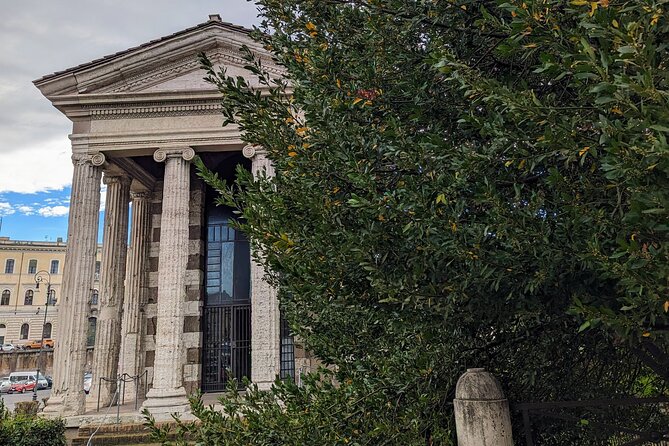
You start with Teatro di Marcello—an early Roman theater area that still carries that dramatic, half-ruined scale. At this stop, the tour focuses on more than gladiators and amphitheaters. You learn about theaters, actors, and stage decorations, and why the structure gives you a medieval-castle vibe.
That castle-like look is part of the charm. It reminds you that Rome doesn’t split cleanly into time periods. Buildings get reused, reinterpreted, and re-skinned as centuries pass. In other words: the city is layered, and this stop helps you see the layers.
The time here is about 20 minutes. That’s just enough to get oriented and get the story behind what you’re seeing, without turning the walk into a lecture.
Ghetto Ebraico di Roma and Tiber Island: Neighborhood History on Foot
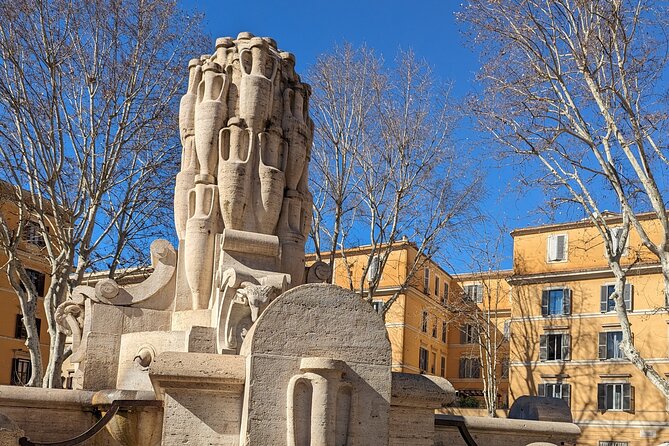
Next up: the Ghetto Ebraico di Roma. This is one of the stops that makes the tour feel like Rome beyond the main sweep. You’re in a neighborhood with a long timeline—ancient roots, unique architecture, and a medieval feel you can still sense in the streets.
What I like about this kind of stop is that you’re not only looking at a monument. You’re moving through a living area. The tour adds context so the streets don’t feel random—they become evidence of how communities evolved.
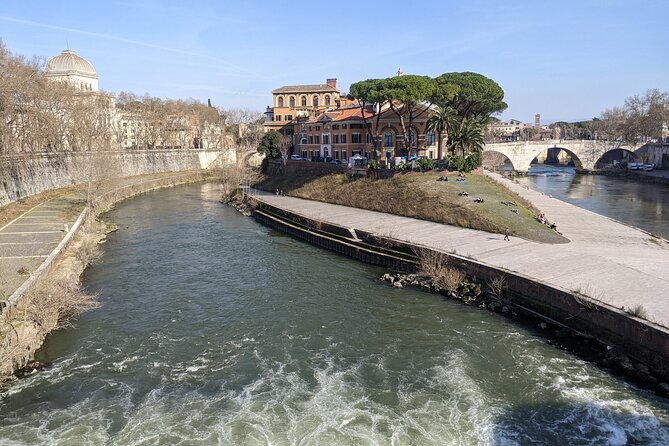
From there, you hop to Isola Tiberina (Tiber Island). The guide frames it with legends and significance tied to Rome’s early inhabitants, plus a lighthearted detail about new true Romans being born every day. Take that as folklore energy, not scientific fact. The real value is how the legend points to the island’s symbolic role in the city’s story.
This section is short—about 20 minutes each—but it’s timed well. It gives you a break from the biggest visual ruins and then returns you to the flow of the walk.
Bocca della Verità and Santa Maria in Cosmedin: Testing a Legend
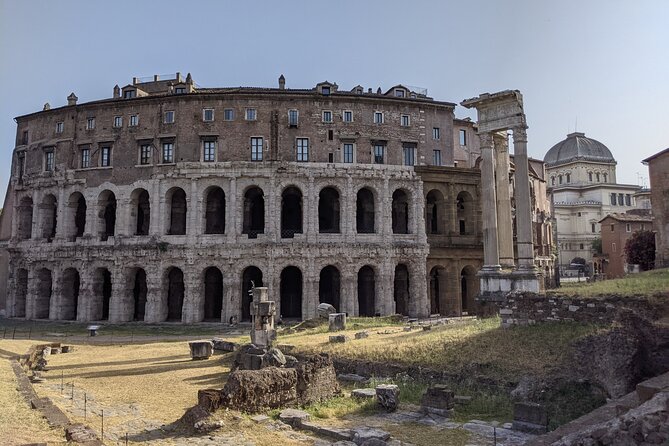
Bocca della Verità is the kind of thing you either rush past or stop for fully. This tour gives it that in-between space where it becomes more than a stunt.
The idea is simple: you test your truthfulness at the famous mouth. But the guide connects it to the surrounding setting—especially the medieval church of Santa Maria in Cosmedin, where relics of St. Valentine rest.
This is one of the stops where you’ll get both story and setting. It’s not just about the object. It’s about the church’s role in the area and how medieval devotion and older traditions can sit close together in the same small pocket of Rome.
If you’re the type who likes playful history, you’ll enjoy this stop. If you’re not, it’s still worth it for the context around Cosmedin and the way the legend has stuck around.
Foro Boario and the First Marble Temple: Seeing Early Rome’s Power
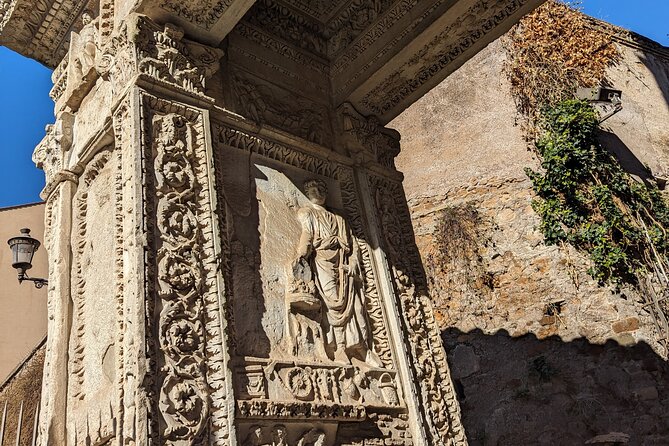
Foro Boario is where the tour shifts from legends to built evidence. Here you learn about typical early Roman temples and get to admire the first temple in marble that’s still well preserved.
Why that matters: marble isn’t just pretty. It signals wealth, ambition, and the choice to represent power with durable materials. You can look at the structure and feel the message in stone—then the guide explains the logic.
The stop is about 20 minutes, so you won’t spend hours in one spot. Instead, it gives you a clear anchor fact about early Roman monumental building: they were already thinking in symbols and long-term presence.
This is also a good place for questions. The guide’s explanations are the kind that help you see how Rome got so good at projecting authority through architecture.
Giardino degli Aranci (Aventine Hill): Views Plus a Great Optical Trick
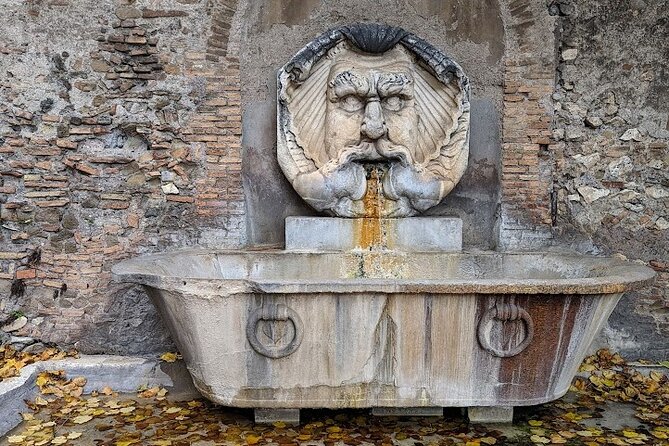
Then you climb to Aventine Hill for Giardino degli Aranci, the Orange Garden. The reward is a panoramic Rome skyline view, and the tour adds a specific optical illusion.
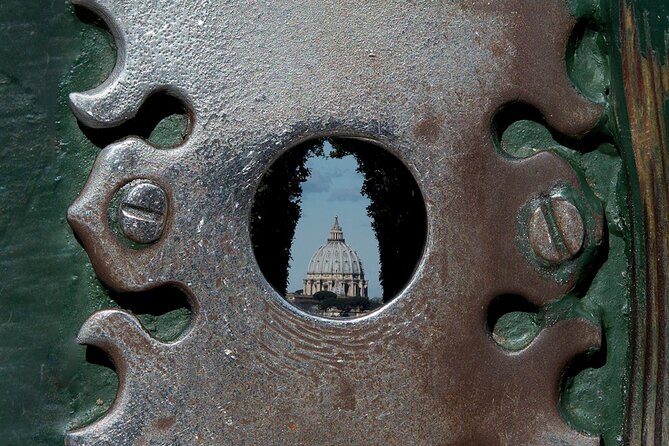
You’ll hear about how St. Peter’s Basilica seems to shrink as you approach. This is the sort of “only in Rome” detail that turns a scenic stop into a mini science lesson.
This section is also where you feel the tour’s “trek” side. You’re ascending, and you’re walking. The walk time here is about 20 minutes, but you’ll likely remember the view longer than the countdown.
Practical tip: this is a great moment for water and sunscreen. The garden can be sunny and exposed. Layered clothing helps too because temperature swings happen, especially if you’re walking in the morning.
Buco della Serratura and the Knights of Malta: A State Within a State
At Buco della Serratura, you do something very specific: peer through the keyhole of the Priory of the Knights of Malta. And through that small opening you encounter a hidden wonder tied to the Sovereign Military Order of Malta.
This is not a normal sightseeing stop. It’s playful, a bit mysterious, and highly memorable because it’s physically interactive. You’re making your own look, not just looking at a sign.
The guide explains how the order maintains its own sovereign territory within the heart of Rome. That “state within a state” idea is one of those concepts that can feel abstract until you see the setting where it’s claimed.
This stop is about 20 minutes. It’s also a good momentum brake—your eyes get the story, your brain registers the oddness, and then you move on.
Testaccio Market and Street Life: Where Rome Feels Local
After the landmarks and big-photo moments, you reach Testaccio—an authentic Roman neighborhood where ancient history mixes with modern life.
This is a favorite kind of stop because it changes the rhythm. You’re away from the most packed tourist corridors and closer to daily routines: the market energy, street art, and that mysterious hill hiding a secret from Rome’s ancient past.
Testaccio is about 30 minutes, and that extra time matters. It’s enough to wander rather than sprint. It’s also enough to soak up the vibe while staying oriented through the guide’s explanations.
I also think this is where you’ll appreciate the tour’s storytelling strength. One of the most memorable themes from the tour is the kind of practical history that connects economics to everyday life. In this walk, that shows up in fun details like the fish tax and how marble got recycled. Those topics don’t sound exciting on paper—until someone explains how Rome actually functioned.
Piramide Cestia: Egyptian-Style Rome and a Wealthy Magistrate’s Taste
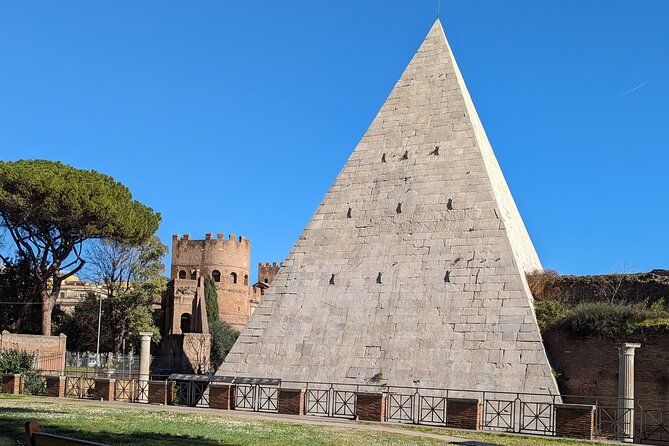
Near the end, you visit Piramide Cestia, the Pyramid of Cestius. It’s a lone survivor of Rome’s fascination with Egyptian culture.
The guide frames it as once part of a larger family of similar structures, tied to the tastes of a wealthy Roman magistrate. The pyramid is also a reminder that Rome collected influences. It didn’t only borrow; it showcased preferences through stone and style.
Time here is about 15 minutes. Short, yes—but it works because by now you’ve built context. You’ve already been learning how layers of time overlap. So the fact that Rome would adopt Egyptian-inspired architecture feels less random.
This final stretch helps you finish with a strong “Rome is strange in the best way” note.
Timing, Meeting Point, and What to Expect From the Walk
The tour runs about 3 to 4 hours. It starts at 10:00 am and is led by an archaeologist with a maximum group size of 10 people, with the tour offered in English.
You meet at Gusto Massimo Bar Bistrò di TIZIANO DI M. E. F. S.r.l. on Via del Circo Massimo, 5a, 00153 Roma. It ends in a different location, and the exact end details are provided with the activity information.
This is also a moderate physical effort route. It includes uphill and downhill sections, so comfortable shoes are non-negotiable. Bring water (the tour recommends you carry a bottle or cup), and in summer, pack sun protection like sunglasses, a hat, and sunscreen.
If weather turns rough, the guide can change or cancel the tour. That matters because Rome history is great, but slippery streets are not a learning tool.
Value Check: Why $3.61 Can Make Sense Here
At $3.61 per person, this tour is priced almost like a promotional event. Even if you assume the amount is more about making it accessible than covering every cost, the structure still delivers value.
Here’s what you’re paying for:
- A small-group walk with a real archaeologist guide (not just a general storyteller)
- 3D augmented reality on your phone, which adds a learning layer
- Stops that include moments you can’t easily recreate on your own, like the keyhole experience
- A route that mixes major touchpoints with lesser-visited neighborhood stops like Testaccio
If you’ve already done a classic highlights tour, this works as a second pass that changes your angle. If it’s your first time in Rome, it helps you build real context early, so later visits feel more meaningful.
Should You Book This Urban Trekking With an Archaeologist?
I’d book this if you want Rome that feels human and readable. You’ll like it if you enjoy asking questions, if you like the idea of learning through walk-and-story rhythm, and if you want your phone to do more than take selfies.
It’s also a great pick if you’ve seen the big sites already and want the city beyond the usual photo stops. Testaccio, the Ghetto area context, and the keyhole Knights of Malta moment all make the walk feel more like discovery than repetition.
Skip it only if you’re looking for a completely flat, minimal-walking experience. The route has uphill and downhill parts, and it’s designed for a moderate fitness level.
FAQ
How long is the Rome urban trekking experience?
It’s about 3 to 4 hours.
What group size should I expect?
The tour has a maximum of 10 travelers.
Is it offered in English?
Yes, the tour is offered in English.
Where does the tour start and when?
It starts at Gusto Massimo Bar Bistrò di TIZIANO DI M. E. F. S.r.l. on Via del Circo Massimo, 5a, 00153 Roma, and the start time is 10:00 am.
What should I bring for the walk?
Wear flat, comfortable shoes. Bring layered clothing and sun protection in summer, and bring a bottle or cup for water.
What if the weather is bad?
The experience requires good weather. If it’s canceled due to poor weather, you’ll be offered a different date or a full refund.