REVIEW · TBILISI
8-Day Trekking Group Tour in Svaneti
Book on Viator →Operated by TrekGeorgia · Bookable on Viator
You get mountain views and village life in the same week. This Svaneti trek runs a classic Mestia-to-Ushguli route with serious scenery, plus enough cultural stops (tower houses, museums, churches) to keep it from feeling like one long hike. You’ll be walking a total of about 58 km, with a smart mix of harder and easier days.
I like two things a lot: the route design gives you big payoff days (like Guli Pass and Koruldi Lakes) without making every day feel punishing, and the trip is built with real support—guesthouses, transport, luggage help, snacks, and expert guides. You’ll also get village context in places like Zhabeshi and Adishi, not just high points and photographs.
One consideration: the trek includes guesthouses with shared facilities on several nights, and that can mean simpler conditions. In particular, you might not always count on hot water in the more basic stops.
In This Review
- Key highlights that matter on the trail
- From Tbilisi to Upper Svaneti: the long day that sets the mood
- Mazeri to Dolra River: a lighter first trek with springs and pine shade
- Koruldi Lakes via Guli Pass: the big elevation moment
- Zhabeshi and Mulakhi: easy walking that still feels real
- Adishi under Tetnuldi: forests, rhododendron, and old stone towers
- Chkhunderi Pass and the Adishi River: where safety meets big views
- Ushguli from above: the highest permanent settlement and museum time
- Chalaadi Glacier and back to Tbilisi: the ending hike that stays practical
- Price and what you’re truly buying for $1,340
- Guides, pace, and the group size sweet spot
- What to bring (and what you can rent)
- Who should book this trek in Svaneti?
- Should you book the 8-Day Svaneti trekking tour?
- FAQ
- How long is the Svaneti trekking tour?
- Where does the tour start and what time?
- How much walking is involved?
- What fitness level do I need?
- What’s the group size limit?
- Is the tour offered in English?
- What ages can join?
- Can I get a refund if plans change or weather cancels the trek?
Key highlights that matter on the trail
- Max 15 people keeps the pace manageable and the group easy to guide
- 58 km of walking with a moderate-fitness level target (14+ welcome)
- Pass days with altitudes: Guli Pass at 2,960 m and Chkhunderi Pass at 2,655 m
- Horse-assisted river crossing for safety on the Adishi River day
- Cultural stops that actually fit the hike, including Ushguli’s ethnographic museum in a 12th-century tower-house
- Good logistics for a trek: air-conditioned vehicle for transfers, luggage moved by car, and most meals included
From Tbilisi to Upper Svaneti: the long day that sets the mood
Day 1 is all about getting into Svaneti and warming up your brain for what you’ll see later. You start in Tbilisi at the Giant Bicycle monument, Rose Revolution Square, with a 7:00 am departure. The day includes long driving—about 9 hours—so think of it as your scenic prelude.
Along the way, you stop in Zugdidi to see the Dadiani Palace, tied to local rule in western Georgia. Then you head to the Enguri Dam, known for being one of the highest arch dams in the world (271.5 m). It’s not the most emotional stop, but it’s a strong reminder that this region is shaped by dramatic engineering and dramatic terrain—both of which you’ll feel again on foot.
As you drive into Upper Svaneti, the scenery shifts to preserved villages with defensive tower houses and medieval-style religious sites. You finish the day in Mazeri, ready for the walking days ahead. If you’re the kind of person who gets cranky after long transfers, pack your patience early. The payoff comes starting Day 2.
Mazeri to Dolra River: a lighter first trek with springs and pine shade
Day 2 is your “find your rhythm” hike. You start from Mazeri and follow the path upstream along the Dolra River. The route includes mineral water springs (a nice break from pure uphill effort), plus a small church set in a pretty spot.
What I like about this day is pacing. The trail moves through meadows and into pine forests, then begins a gradual ascent until you reach a border post area. After that, you turn back and return to Mazeri.
It’s only listed as a one-day trek, but don’t treat it like a stroll. You’re still walking and gaining effort, just without the punishing altitude push of later days. This is the day to test your shoes and your trekking poles (if you have them), and to figure out how your pack sits when the trail starts to climb.
Koruldi Lakes via Guli Pass: the big elevation moment
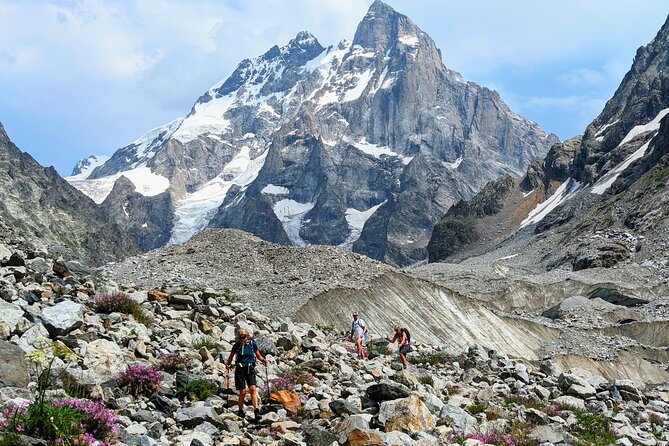
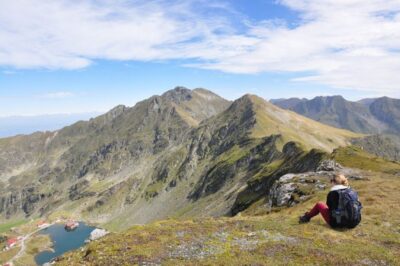
On Day 3, the trek gets serious in the best way. You move from Mazeri to Mestia, then hike to Koruldi Lakes through Guli Pass. Guli Pass sits at 2,960 m, and the route calls for good physical effort on the ascent.
The trail then opens into a valley descent, and you reach the lakes at a point where the mountain view hits hard. Koruldi Lakes are small alpine lakes, but the setting matters: you’ll see major peaks around you, including Ushba.
This is the day many people remember, because it combines altitude work with a reward that feels cinematic without needing any trick lighting. If you’re prone to going out too fast, resist that. You want steady effort for the pass, because the descent to the lakes feels better when your legs aren’t already fried.
Zhabeshi and Mulakhi: easy walking that still feels real
Day 4 is your practical reset day. You trek from Mestia area toward the Mulakhi community of Zhabeshi village. The description is refreshingly straightforward: the route is easy, often follows an off-road car route, and the trail is well marked.
Time on this hike is around 6 hours. You’ll still get village texture and mountain air, but you’re not constantly fighting steep climbs. This matters on a multi-day trek because it keeps you from feeling like you’re in recovery mode all week.
Culturally, the value here is that you’re not just passing a place—you’re walking into a community setting. You also set yourself up for the more scenic, more altitude-influenced days that follow.
Adishi under Tetnuldi: forests, rhododendron, and old stone towers
Day 5 is a classic Svaneti combo day: moving from mountain slopes into forests and then up again toward an old village. After breakfast you hike into the wilderness, heading toward the slopes of Tetnuldi. You pass a ski resort area, then descend into birch trees and rhododendron bushes.
After crossing a mountainous small river, you reach alpine meadows, and eventually Adishi village. Adishi is known for its stone towers and houses built centuries ago, tucked below Tetnuldi and alongside a roaring river. That setting is a big part of why people love Svaneti—this is architecture and geography built together, not pasted on as an attraction.
The hike length is about 6 hours. It’s not presented as a technical day, but the day still includes elevation changes and changing footing as you move through forests, meadows, and river crossings. If your knees are sensitive on descents, plan to take your time in the forest-to-meadow transition.
Chkhunderi Pass and the Adishi River: where safety meets big views
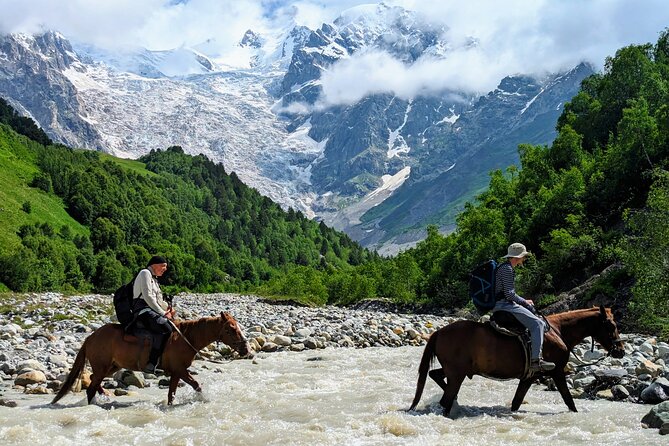
Day 6 is one of the most interesting logistics days on the route. You start early and follow the river upstream, crossing it on foot for about an hour—then comes the tricky part: the Adishi River crossing.
For safety, you get on horseback to cross the river. After that, you climb toward Chkhunderi Pass at 2,655 m. From the pass, you get panoramic views of the Adishi Glacier.
Lunch is eaten on the top ridge while you enjoy the views. Then you descend into the Khaldechala river valley, taking about two hours of easier walking to reach Khalde village. Khalde has a painful story: it was destroyed in the 19th century by Russian soldiers. From there, the route follows an off-road to Iprali for the night.
Eight days of trekking can blur together, so what makes Day 6 stand out is the mix: a high pass, a glacier view, and a historically grounded stop. It’s also where you feel that the guide team is thinking about safety first, not just speed.
Ushguli from above: the highest permanent settlement and museum time
Day 7 is built for morning energy and a satisfying arrival. You trek through traditional Svan villages, passing Kala and Davberi, then walking through forest. From above, you reach Ushguli.
Ushguli sits at the foot of Mount Shkara, where the Enguri and Kvishiri rivers meet. It’s described as the highest permanent settlement in Europe at 2,200 m, and it’s famous for the medieval-style towers and churches that still shape everyday life.
The best part: you get time for culture that’s connected to place. You visit the Ushguli Ethnographic Museum inside a 12th-century tower-house, then you see the medieval Lamaria church (Assumption of the Mother of God). After this, you overnight back in Mestia.
This day works if you like a finish that feels more than scenery. The museum visit turns your earlier walks into something with context—why these towers matter, why churches sit where they do, and how mountain life shaped architecture.
Chalaadi Glacier and back to Tbilisi: the ending hike that stays practical
Day 8 brings you back toward civilization, but not too abruptly. After breakfast you depart for Tbilisi. On the way, you stop at Chalaadi Glacier and take a short walking component upstream along the Mestiachala River. After about 1.5 km, you reach the finish point where the river is born.
Then you continue the drive back to Tbilisi, ending back at the meeting point. It’s a gentle closer—good if you’re tired, and still nice if you want one last mountain moment without a full pass day.
Price and what you’re truly buying for $1,340
At $1,340 per person for an 8-day group trek, you’re paying for more than hiking time. You’re buying reduced friction: air-conditioned vehicle transfers, luggage transport by car during the hiking days, and expert leadership over the long drives and the trail segments.
Most meals are included: breakfast for 7 days, lunch for 6 days, and dinner for 7 days, plus bottled water and snacks. Lodging is also structured—private facilities on two nights each in Mazeri and Mestia, and shared facilities on nights in Zhabeshi, Adishi, and Iprali. That mix is common on multi-night treks, but it’s worth noting because it’s where the “simple” part of guesthouses can show up.
In real terms, the price looks fair if you want guided safety and route management, plus a cultural layer, without doing all the planning yourself. If you’re the DIY type with your own transport and gear, you might be able to build a cheaper version. But you’d lose time, and you’d take on the risk of coordinating mountain passes and village stays on your own.
Guides, pace, and the group size sweet spot
This is a small group trek, capped at 15 travelers. That matters more than people think. It means you can move at a workable pace without constant regrouping, and your guide can adjust when weather or trail conditions change.
The guide style is repeatedly praised in ways that actually matter on a trek: punctuality, careful attention, and real knowledge of the area. Names that come up include Gogi and Dito, with others like Nugo mentioned as well. The common thread is leadership that checks everyone’s wellbeing and keeps things feeling safe even when the terrain gets loud—like on the river crossing day.
Also pay attention to the “pace for everyone” idea. You’ll cover about 58 km, but the itinerary is staggered so you’re not doing one extreme push every single day.
What to bring (and what you can rent)
Trekking gear like trekking poles and backpacks can be rented, so you’re not forced to buy everything before you go. Still, if you can bring your own poles and a pack you know, you’ll feel more comfortable on Day 3 and Day 6 when footwork matters.
You’ll also be carrying a day pack during hikes, while luggage is transported by car during hiking days. That’s a big quality-of-life upgrade for a multi-day trek. Less weight on your back usually means less knee drama.
One more practical note: you’ll be living in guesthouses across several villages. That makes a small pack of essentials useful—light layers, a rain shell if you have one, and something warm for the passes.
Who should book this trek in Svaneti?
This tour is a strong fit if you want:
- a guided trek with mountain passes and glacier views
- a route that includes villages and cultural stops, not only high points
- a manageable group size (max 15), plus luggage support and meal coverage
It might not be the best fit if:
- you expect full-service hotel comfort every night
- you need guaranteed hot water at shared-facility guesthouses
- you want a short trek with minimal driving and early mornings (start is 7:00 am and Day 1 is a long transfer day)
If you’re moderately fit and okay with uneven terrain, you’ll likely enjoy it a lot.
Should you book the 8-Day Svaneti trekking tour?
I’d book this if you’re excited by the mix of passes, glacier views, and real Svan village culture, and you want it handled by a team that keeps safety and pacing in mind. The itinerary has enough variety to feel like a full Svaneti experience, not a repetitive series of uphill slogs.
I’d think twice only if shared-facility nights and simple guesthouse conditions would stress you out. If you can handle that, the value is solid: most meals are included, lodging is set, transfers are arranged, and the guiding seems to be a genuine strength of the operation.
FAQ
How long is the Svaneti trekking tour?
It runs for about 8 days.
Where does the tour start and what time?
The meeting point is the Giant Bicycle monument at Rose Revolution Square in Tbilisi, and the start time is 7:00 am.
How much walking is involved?
The tour involves about 58 km of walking in total.
What fitness level do I need?
You should have moderate physical fitness.
What’s the group size limit?
The maximum group size is 15 travelers.
Is the tour offered in English?
Yes, it is offered in English, and the guide may be multilingual.
What ages can join?
The minimum age is 14 years.
Can I get a refund if plans change or weather cancels the trek?
You can cancel for a full refund up to 24 hours in advance. If the trek is canceled due to poor weather, you’ll be offered a different date or a full refund.