REVIEW · DJERBA
Desert tours and adventurous camel trekking through the Sahara
Book on Viator →Operated by Wüstentour - Tunesien - Douz - Kameltrekking · Bookable on Viator
Your phone will feel obsolete here. This 8-day Sahara camel trekking trip from Djerba to Douz and the Erg Oriental dunes pairs Bedouin camp evenings with camel-and-on-foot dune hikes that make the silence real. The one hesitation: at $1,110.18 per person, some people felt the price wasn’t a great match for value compared with other desert tours.
I also like that it’s private, so you’re not stuck in a big mixed crowd while you’re trying to enjoy starry nights and slow mornings with your crew. You’ll want a moderate fitness level, since sand walking is part of the deal, and the days run on desert timing, not city timing.
In This Review
- Key highlights (the good stuff you actually feel)
- Djerba to Douz: starting at the Gate of the Desert
- Your first Bedouin night: tents, stars, and that fine-sand quiet
- Days 2–6 (the dune days): trekking with dromedaries and fresh camp stops
- The Bedouin camp setup: food, fire, and music under the stars
- Your pickup back to reality: 4×4 to Douz and souks with dates
- Matmata troglodyte houses: Berber cave dwellings after the dunes
- Ferry time and Djerba’s coast: leaving the mainland and arriving at the sea
- Price and value: is $1,110.18 per person worth it?
- Who this tour fits best (and who should think twice)
- Should you book? My take on the call
- FAQ
- How long is the desert camel trekking tour?
- Where does the tour start and end?
- Is this a private tour?
- Is pickup offered?
- Does the tour include camel trekking and hiking in the dunes?
- Is the tour suitable for travelers with only moderate fitness?
- What is the cancellation policy?
Key highlights (the good stuff you actually feel)
- Bedouin camp evenings with traditional, home-cooked dishes and campfire music
- Camel trekking plus on-foot dune hikes (not just a ride, not just a walk)
- Erg Oriental dunes near Douz, with big-sky sunsets and starry nights
- Mounir as a guide name you’ll hear in feedback for his friendly, helpful style
- Matmata troglodyte cave houses to balance desert quiet with Berber history
- Vegetarian accommodation mentioned in reviews, so it’s worth asking upfront
Djerba to Douz: starting at the Gate of the Desert
Most desert tours in Tunisia promise adventure. This one starts by setting your expectations early: you’re going to earn that silence. The trip begins in Djerba, then orients you around Douz, often called the Gate of the Desert, a key crossing area toward the Sahara.
A nice detail: before you go fully “off-grid,” you share a meal together and you can even buy a turban if you want the full movie-poster look. Then comes the turn: after dinner, you drive about 90 minutes into the desert, where the Bedouin team and dromedaries are ready, tents get set up, and you can either sleep under the stars or in the camp setup.
What I like about this start is the pacing. It doesn’t drop you into deep sand shock on day one and then act like that’s entertainment. You get the comfort of a prepared camp, plus the emotional payoff of seeing dunes stretch out like a blank page.
Your first Bedouin night: tents, stars, and that fine-sand quiet
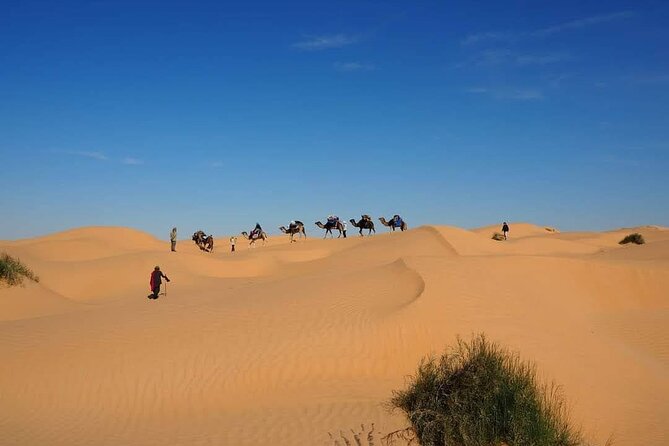
There’s a specific kind of quiet in the Sahara—so fine it feels like it has texture. After the drive in, the camp team prepares the first-night setup, and you get time to settle in while your surroundings do their job.
If you prefer sleeping outdoors, you’ll likely have the chance to choose a spot and put your sleeping bag in a place that gives you the best view of the sky. That matters more than you’d think. The best moments usually aren’t the scheduled ones. They’re the “nobody’s talking” moments when the wind moves over the dunes and the stars show up like someone turned off the room lights.
One practical thought: even if you’re only “watching,” you’ll feel cooler at night than you might expect in desert regions. Bring whatever you can that helps you with temperature swings, and don’t plan to rely on one thin layer.
Days 2–6 (the dune days): trekking with dromedaries and fresh camp stops
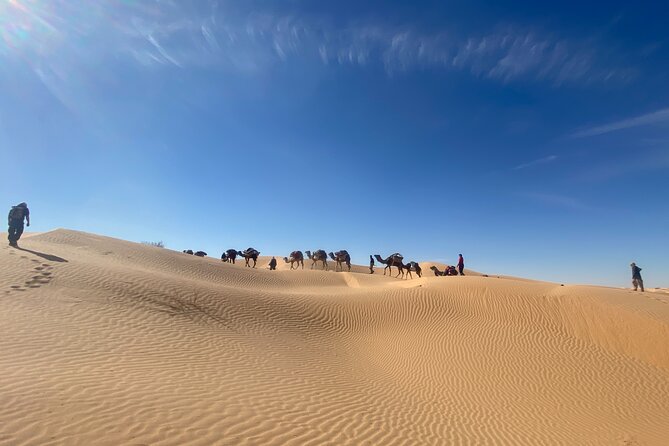
The middle of the trip is built around the core fantasy—walking dunes and riding camels through Erg Oriental territory. Your route includes daily stop names—El Hedan, La Ghuezza, Hashiat Erramal, Thuall Erbaier, and Bir Abdhull—which are essentially the “chapters” of the desert. Each day moves you into a new stretch of sand country, with trekking and camp life as the glue.
Here’s the part that sets this kind of tour apart from a quick camel ride: you’re not just there for a photo. You’re out long enough to feel distance. The desert stops being a concept and becomes your daily surroundings. The wind, the silence, and the slow rhythm of trekking start to take over your brain.
What you should expect physically:
- sand walking (even if you ride some)
- long stretches where the horizon stays the same shape
- a routine built around camp meals and evening downtime
There’s also an advantage to the “moderate fitness” note. It tells you this isn’t marketed as a survival expedition, but it still won’t be a stroll. If you’re used to hiking a few times a week, you’ll probably feel fine. If you mostly do flat city walks, you’ll want to do a little sand-walking training before you go, or at least be honest with yourself about your comfort level.
The Bedouin camp setup: food, fire, and music under the stars
This is where the reviews really line up. The evenings around the campfire are a repeated highlight, with music and a strong sense of care from the Bedouin crew. People describe going from everyday noise to desert silence and finding the kind of emptiness that actually feels relaxing, not boring.
Food shows up as another key point. One person said the food tasted OK and that the staff worked hard. Another said the tour delivered the kind of evenings you remember—traditional home-cooked meals, plus the social warmth of gathering around the fire.
Vegetarian eaters get at least one strong signal from the feedback: someone specifically mentioned they made an effort for vegetarians. That doesn’t mean every meal will match every diet perfectly, but it’s a good sign that they think about dietary needs. If you have specific restrictions (not just vegetarian), message the operator before you go and be very clear.
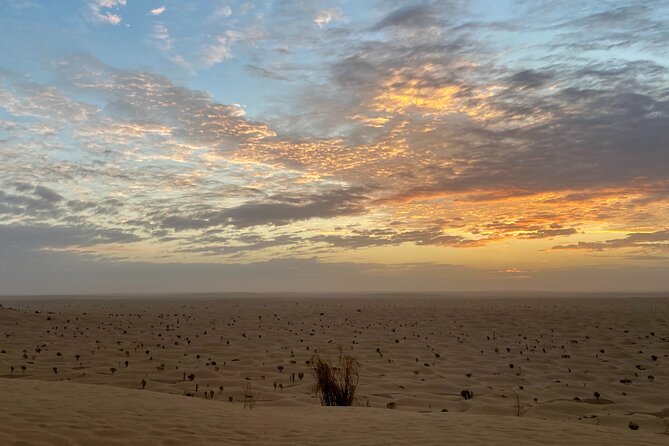
Also, if you’re a “sunrise and sunset person,” you’re in the right place. Multiple reviews mention daily sunrises and sunsets as standout moments. When you’re in dunes, light becomes part of the itinerary even if nobody is pointing at a schedule.
Your pickup back to reality: 4×4 to Douz and souks with dates
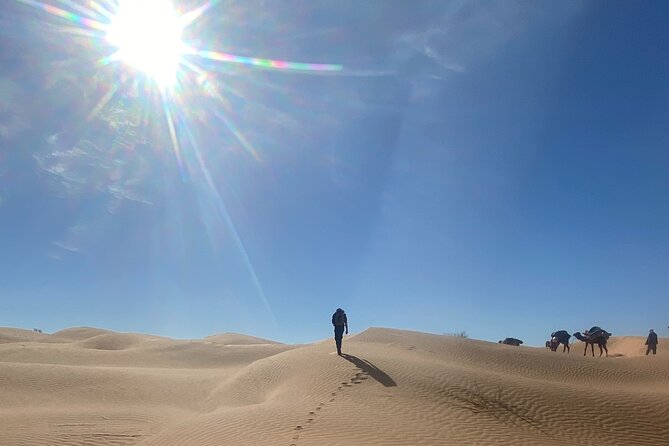
On day seven, the trip pivots. You wake up, eat a hearty breakfast in nature, and then you get picked up around 9:00 a.m. in a 4×4 off-road vehicle from the Bedouin camp. From there, you head to Douz.
Douz is called the Gate of the Desert for a reason: it’s the practical hinge between desert travel and settled life. In Douz, you get city time and a traditional souks visit. You also get the added perk of being in a place known for high-quality dates. If you want a desert souvenir that’s actually edible, this is your moment.
This portion is also a good reset for your body. After days of sand walking and nighttime outdoor sleeping, it feels good to move slower through town streets and let your senses re-calibrate. You still get the desert flavor, just in a more human scale.
Matmata troglodyte houses: Berber cave dwellings after the dunes
After Douz, you drive about 1.5 hours to Matmata, famous for the troglodyte houses—cave dwellings used by Berber communities. You can visit one cave home to see how people retained their way of living, and in the visit you’re encouraged to ask questions and take photos with the owners.
This is the part I appreciate for balance. If your only goal is dunes, you might feel restless leaving the desert. But Matmata gives you another layer: people shaped their homes around the environment instead of just touring it. It turns your “what is this place?” feelings into “how did people adapt here?” curiosity.
Practical note: cave homes can feel cooler and more enclosed. If you’ve spent days outside, it may feel like stepping into shade. Bring a light layer for that transition if you run hot.
Ferry time and Djerba’s coast: leaving the mainland and arriving at the sea
After Matmata, you continue toward Djerba and you use a ferry that takes about 20 minutes across the Mediterranean. The route crosses from the mainland area to the island, then continues through Djerba, which you’ll associate with olive groves and that turquoise-blue sea vibe.
This last stretch is a quiet reward. You’ve spent most of the week in sand and sky; now you get water and calmer scenery that doesn’t ask you to trek for it. It’s the kind of ending that helps you land back in real life without feeling like your desert trip ended with a thud.
On day eight, you have breakfast and, depending on your flight time, you transfer to the airport. That’s a simple wrap-up after an intense week.
Price and value: is $1,110.18 per person worth it?
Let’s talk money plainly. At $1,110.18 per person for an 8-day private desert trekking experience, you’re paying for more than transportation. You’re paying for a full week of:
- camel and on-foot trekking time
- multiple camp days and camp setup
- a Bedouin team on site
- meals in remote settings
- a guide experience that keeps everything organized
That said, feedback isn’t fully one-sided. Some people flagged price-performance imbalance, saying they found better services elsewhere for about 400 euros less, and they recommended contacting other providers before booking. Others still gave strong praise for organization and care, saying the communication beforehand and on-site logistics were excellent.
So here’s how I’d judge value if you’re deciding:
- If you want a longer, slower desert experience with camp life and trekking time, the price may feel more reasonable.
- If you’re comparing purely on what you get for the euro/dollar, you might feel the cost is on the high side.
My best advice: don’t only compare the sticker price. Compare what’s included in the actual experience—trekking style, camp quality, guide attention, and how meals work for your needs.
Who this tour fits best (and who should think twice)
This tour fits best if you:
- want a true desert trek week, not a half-day camel ride
- like the campfire rhythm—shared meals, stars, and music
- enjoy switching gears from desert quiet to Matmata cave homes
- want a private tour where your group can set the pace emotionally
It may be a less perfect fit if:
- solo women have special concerns about how the tour environment feels in practice (one review raised that it wasn’t necessarily suitable for women traveling alone)
- you’re extremely cost-sensitive and already know desert tours in other countries and expect the same value for less
If either of those is you, ask more questions before booking. The right operator can usually clarify how the day-to-day feels, how groups are managed, and how comfort needs are handled.
Should you book? My take on the call
I’d book this if you want the classic Sahara feel: dunes you walk and ride through, camps with Bedouin hospitality, and that “from noise to silence” effect people keep describing. The Matmata add-on is also a smart pairing—it prevents the trip from being a one-note experience.
I’d think twice if you’ve already done desert tours elsewhere and you’re trying to maximize value per dollar. The price has enough pushback in feedback that you should compare options carefully, not just book the first one that looks magical.
If you do book, do two things that improve your odds:
- Confirm your dietary needs clearly in advance, since vegetarian support is mentioned but not guaranteed for every nuance.
- Be ready for moderate physical effort and desert timing. This works when you treat it like a slow journey, not a race.
FAQ
How long is the desert camel trekking tour?
It’s listed as 8 days (approx.).
Where does the tour start and end?
The experience starts in Djerba, Tunisia and ends back at the meeting point.
Is this a private tour?
Yes. It’s private, meaning only your group participates.
Is pickup offered?
Yes, pickup is offered.
Does the tour include camel trekking and hiking in the dunes?
Yes. The experience is described as adventurous camel trekking, and it includes hikes through the dunes on foot or on camel back.
Is the tour suitable for travelers with only moderate fitness?
Yes. The guidance says travelers should have a moderate physical fitness level.
What is the cancellation policy?
You can cancel up to 6 days in advance for a full refund (must cancel at least 6 full days before the start time). If you cancel 2–6 days before, you get a 50% refund. If you cancel less than 2 days before, there’s no refund. The experience requires good weather and a minimum number of travelers; if it’s canceled due to poor weather, you’re offered a different date or a full refund.